When I started out, I didn’t understand that there was a way to read to medical/scientific papers. Boy, was I wrong. I wasted hours upon hours going through so many papers trying to make sense of everything. Time is a resource and we should be wary of how we use it.
Somethings that we would benefit from understanding:
- How fast or slow we read has nothing to do with us taking hours to read a medical paper – classic “my eyes are reading but my brain isn’t processing move”
- We take in a lot of unnecessary information when we read a whole paper without a strategy and this risks forgetting some of the key information
- You may need to sit down for this one; you do not need to read the whole paper in a sequence
Let’s Look at a Paper Section-Wise
TITLE
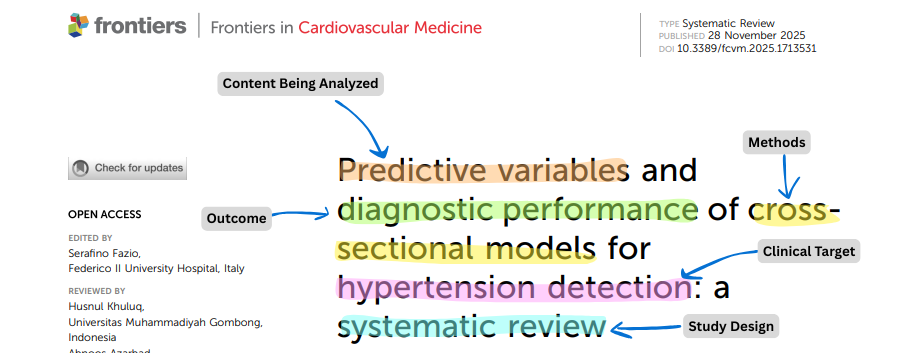
The title itself can tell us a lot about the paper.
The image below is an example of how the title of a paper can be broken down. Typically, the title may have the population (if it is a population based study; ie, not applicable to systemic review and meta-analysis), the clinical target/disease under consideration, methods and desired outcome. However, it is not limited to that. So, it is always a good idea to actually pay attention to the tile because there is a lot of substantial information that we can gather from there.
ABSTRACT
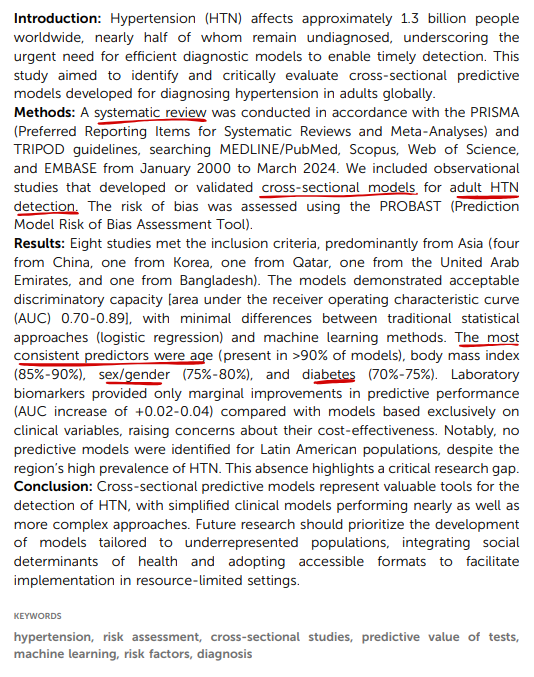
This is a summary of the whole paper. Bird’s eye view, the most significant parts are mentioned here, including the keywords.
First, it will have the introduction/aim. Then, it will have the method, study design and sample population. Then, results which would contain the key findings and the conclusion.
INTRODUCTION
It typically has 3 paragraphs. In the first 2 paragraphs the objective is mainly defining the problem, introducing it while describing what has been done in this field (specific to the part of the topic that has been chosen) and why more study needs to be done.
In the third/last paragraph, the authors describe the study aims.
So, paragraph wise, the introduction aims aims to answer a few key questions;
- What’s known?
- What’s unknown/Controversies surrounding the topic/What needs fixing?
- How will this study fix it?
METHODS
It is simple. What methods section answers is everything that was done during this study.
- The study design
- The who, the what and the how
RESULTS
This is where the authors describe the study findings. The word “results” is self-explanatory.
What we can gather from here include:
- Sample Size
- Population Characteristics
- Primary Outcome
- Secondary Outcome
There are 2 parts:
- The literature
- Tables/figures/other media
DISCUSSION
Averaging at 8 paragraphs.
First paragraph:
Summary paragraph: What the authors did? Why they did it? Summary of the key findings from the results section.
Middle paragraphs (2~7)
The authors compare what has been done in the field as described in the introduction and the study findings, all the while discussing the relevance of the study done.
The questions that are answered here are:
- Implications of the results
- Mechanisms of the findings
- How the results fit into the literature?
- Why are the results so relevant?
Last paragraph
Limitations and strengths.
conclusion
This is a comparison between existing data and main findings of the research, highlighting how the “problem” identified earlier has been either fixed or the new information that has been discovered during the study which can be further studied so that the identified problem can be fixed in the future. This is typically, about 2-3 sentences.
Why Are You Reading a Paper?
You have to be clear about the goal of reading.
When we look at a paper as a physician, we need a specific question answered (eg: which medication has had better results long term specific to YOUR patient etc.).
While doing a research project, the goal of reading will depend on the stage of the research project. There are a lot of moving parts in a research project and the papers that you might read during the beginning phase will be different from when you write you manuscript.
inquiry-based reading
This is when you read a paper to answer a specific question. When you do this, you find your information quicker and remember it better.
3 step process:
- Specific Question
- Find the Answers
- Verify the authenticity – is the answer trustworthy?