After submission, the waiting begins.
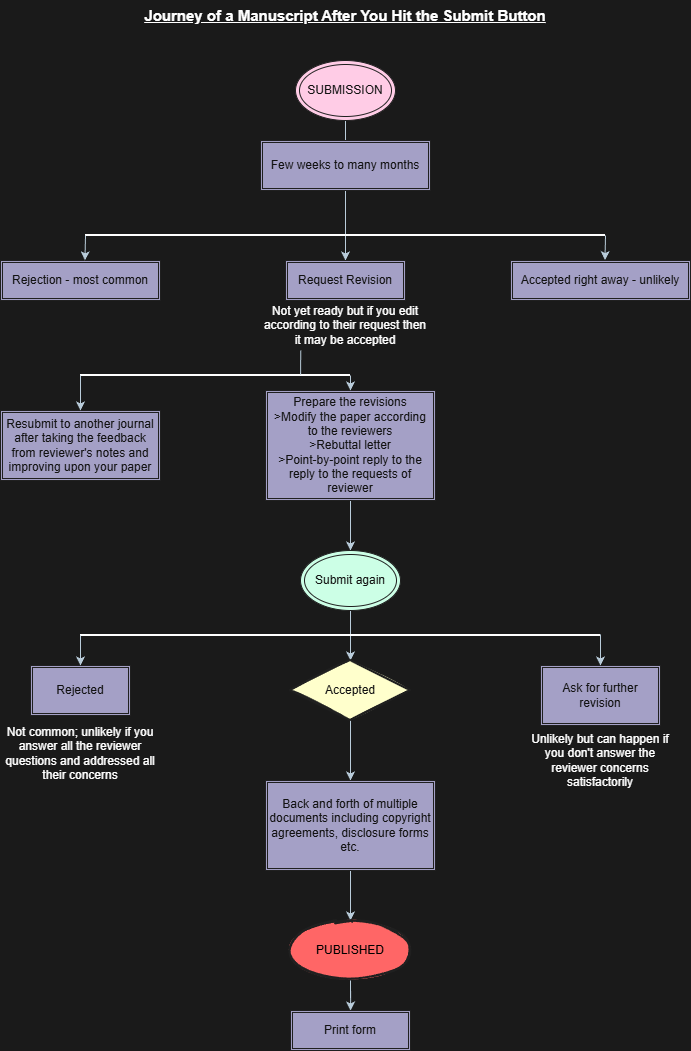
It can take a few weeks or sometimes many months. I once received a response from BMJ after six months. So if you find yourself constantly checking your inbox, take a breath. This is normal.
There is no need to panic.
The people reviewing your manuscript are usually extremely busy clinicians and researchers. Peer review is not a quick skim. They don’t just read your paper they critically analyse it. They assess its novelty and relevance. They examine your methodology. They compare your images with your descriptions. They scrutinise your statistics. They evaluate whether your conclusions are justified.
That level of evaluation takes time, time that most academics already struggle to find.
So once you submit, the healthiest thing you can do is this: submit it…and then let it go.
After Peer Review: The Three Possible Outcomes
Eventually, you will receive an email. It will typically contain one of three decisions:
1. Rejection
If you submitted to a good journal, this is actually the most common outcome.
And it’s okay.
Rejection is not a verdict on your intelligence or your future in research. It is part of the process. Often, it is simply a matter of fit, priority, or scope.
What you should do:
- Read the reviewer comments carefully.
- Extract the constructive feedback.
- Revise your manuscript accordingly.
- Discuss the comments with your mentor.
- Then resubmit – preferably to a more appropriate journal.
Every rejection can sharpen your paper.
2. Accepted Without Revisions
Unless your manuscript is truly exceptional, this is rare.
And interestingly, if it does happen, it may sometimes suggest that you could have aimed higher. Journal selection matters. (I’ll discuss how to choose the right journal strategically).
Immediate acceptance is wonderful; but it’s not the usual path.
3. Request for Revisions
This is the most reassuring response.
A revision request means your paper has potential. The reviewers believe it is publishable, with changes.
If you respond thoughtfully, address every comment clearly, and submit a well-structured rebuttal letter, your chances of acceptance are high.
The Flow Continues
After revising and resubmitting, you enter another waiting period. And once again, you will receive one of three outcomes:
- Acceptance
- Rejection
- Revision
If you have carefully addressed all reviewer concerns and written a strong rebuttal, acceptance at this stage is common.
However, if you are rejected after revision, it may signal that your manuscript needs deeper restructuring or reconsideration before submitting elsewhere.
And sometimes? You may be asked to revise again.
I was once asked to revise the same paper three separate times.
It happens.
Peer review is rarely linear. It is iterative. It tests not just your manuscript, but your patience.
And that’s normal.
Here is the truth:
Most people don’t fail at publishing because they aren’t capable.
They stop because the waiting feels long and rejection feels personal.
Don’t stop.
Revise. Learn. Resubmit. Repeat.
That is the entire game.